
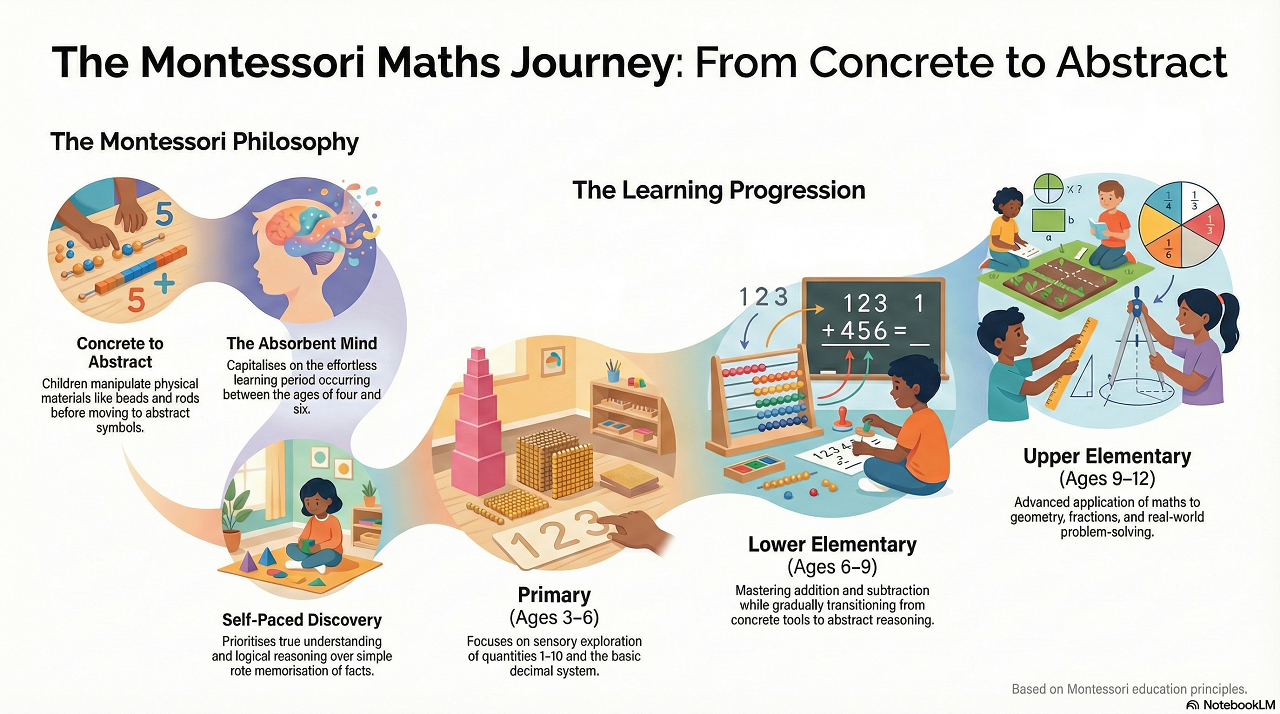
Montessori Math is a hands-on, child-led approach that builds deep number sense by introducing concepts through concrete materials before moving to abstract symbols. Unlike traditional math education that relies on rote memorization, Montessori prioritizes true understanding and self-paced discovery.
In Montessori, students start with real-world, tangible quantities— stacking number rods, building with blocks or counting beads—so they understand why math works and develop confidence and logical thinking. This helps prevent math anxiety from the very beginning.
From a earliest age, numbers are part of a child’s world. What child doesn’t love telling you how old they are?
One of the best features of a Montessori education is that it makes math fun and interactive for students. Instead of just presenting numbers on paper, Montessori allows kids to experience math with their hands, transforming it from something abstract to tangible. In our classroom, students are introduced to math through thoughtfully designed Montessori materials that use color, shape and movement to bring concepts to life.
The Montessori Math Philosophy
Dr. Maria Montessori believed that people are naturally inclined to seek order—to organize their environment, observe relationships, and recognize patterns. With proper guidance and nurturing, every child can develop the ability to reason and calculate.
Dr. Montessori observed that young children are most receptive to learning mathematical concepts between the ages of four and six — a period she described as the “absorbent mind,” when learning happens effortlessly. Montessori math lessons are intentionally designed to meet children at this stage.
-

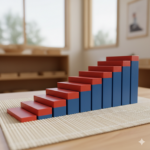
- Brown Stairs
-
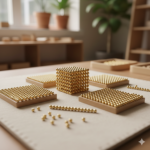
- Golden Beads
-
- The Pink Tower

-
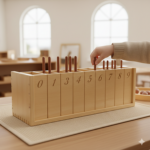
- Spindle Boxes
-
- Numbered Cards

Math in the Montessori Classroom
Montessori education introduces mathematics to children through touch, shapes and “feel.” In the sensorial area of a Montessori classroom, students can get their first experience with geometry through shapes and learn other mathematical lessons through the five senses.
Through use of blocks, shapes and colors, students — especially younger ones — get a hands-on feel for how numbers work as a part of their universe.
Key Montessori Math Materials
These Montessori materials make abstract concepts tangible, allowing children to self-correct as they explore.
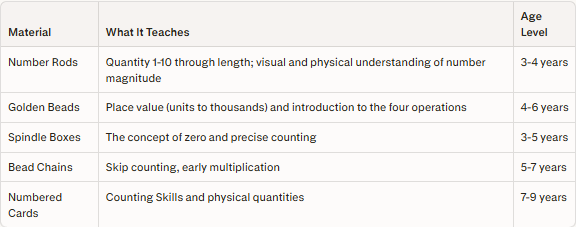
- The Number Rods: Usually colored red and blue, help children develop the concept of numbered sequences.
- The Golden Beads: Often used to introduce the concepts of addition, subtraction, decimals and squaring numbers by allowing students to manipulate the beads in units of ten.
- The Pink Tower: Helps build an early understanding of sizes and dimensions as children stack the pink blocks — foundational skills for mathematical thinking.
- Brown Stairs: Teaches students to analyze sizes and build mathematical progressions
- Numbered Cards: Used to build counting skills and help children match symbols to the physical quantities they’ve learned.
Montessori Math Progression by Age
Montessori Math follows a clear sequence from sensory exploration to advanced operations, tailored to the child’s readiness:
- Primary (Ages 3-6): Students focus on quantities 1-10 using materials such as number rods and sandpaper numerals. Then they move to the decimal system using golden beads to understand place value (units, tens, hundreds, thousands). Many children also begin the four operations using concrete materials before moving toward abstraction.
- Lower Elementary (Ages 6-9): Students master addition and subtraction and begin exploring multiplication and division using materials like the Stamp Game, bead frames and bid chains (including skip counting chains). The focus is on mastering operations while gradually transitioning from concrete materials to more abstract reasoning.
- Upper Elementary (Ages 9-12): Students move further into abstraction, using tools such as large bead frames for complex operations. They expand into advanced work with fractions, decimals, geometry, and pre-algebraic thinking, applying math to real-world problem solving.
Montessori Math at Home
As a parent, you can help introduce your child to math concepts at home. Here are a few simple ways to do this:
- Make it count in the kitchen: Filled with measurements and amounts, recipes offer ready-made math lessons. Have your child count ingredients or watch as you add up cups and tablespoons.
- Learn more at the store: Having your child help count items at the grocery store or tally up change gives them an early lesson on the practical applications of mathematics.
- Play the game: Try making shapes and patterns with common objects like crayons, pencils, and stickers. In the car, count road signs or specific colored cars.
By bringing these math concepts into the real life, you reinforce the Montessori belief that math isn’t just a school subject—it’s a way of understanding the world.
Conclusion
Montessori Math offers a developmentally aligned, research-informed pathway helping children build genuine number sense and confidence instead of simple rote recall. By combining carefully sequenced materials with observation-driven guidance, it respects each child’s pace while still maintaining high expectations for mathematical thinking—an approach that is increasingly supported by modern insights from cognitive science and early childhood education.
Contact Us
Established in 2004, La Prima Casa has served Miami families for over two decades, building a reputation as the most reliable Montessori school in the area. Our stable leadership team and exceptionally low teacher turnover—many educators have been with us for 10+ years—ensure consistent, high-quality care that children and parents can depend on.
Ready to see our proven approach in action? Book your personalized school tour today and experience the La Prima Casa difference firsthand.